
Foundation Repair · Problem Signs
Bowing
Foundation
Walls
Maryland's Piedmont clay holds water for weeks after rain. That saturated soil pushes against your basement wall with force. When the wall bows inward — it's that pressure winning.
Carbon fiber straps for minor deflection. Wall anchors for moderate deflection with gradual straightening. Drainage correction to remove the pressure source. OBW measures first, then recommends. Never the other way around.
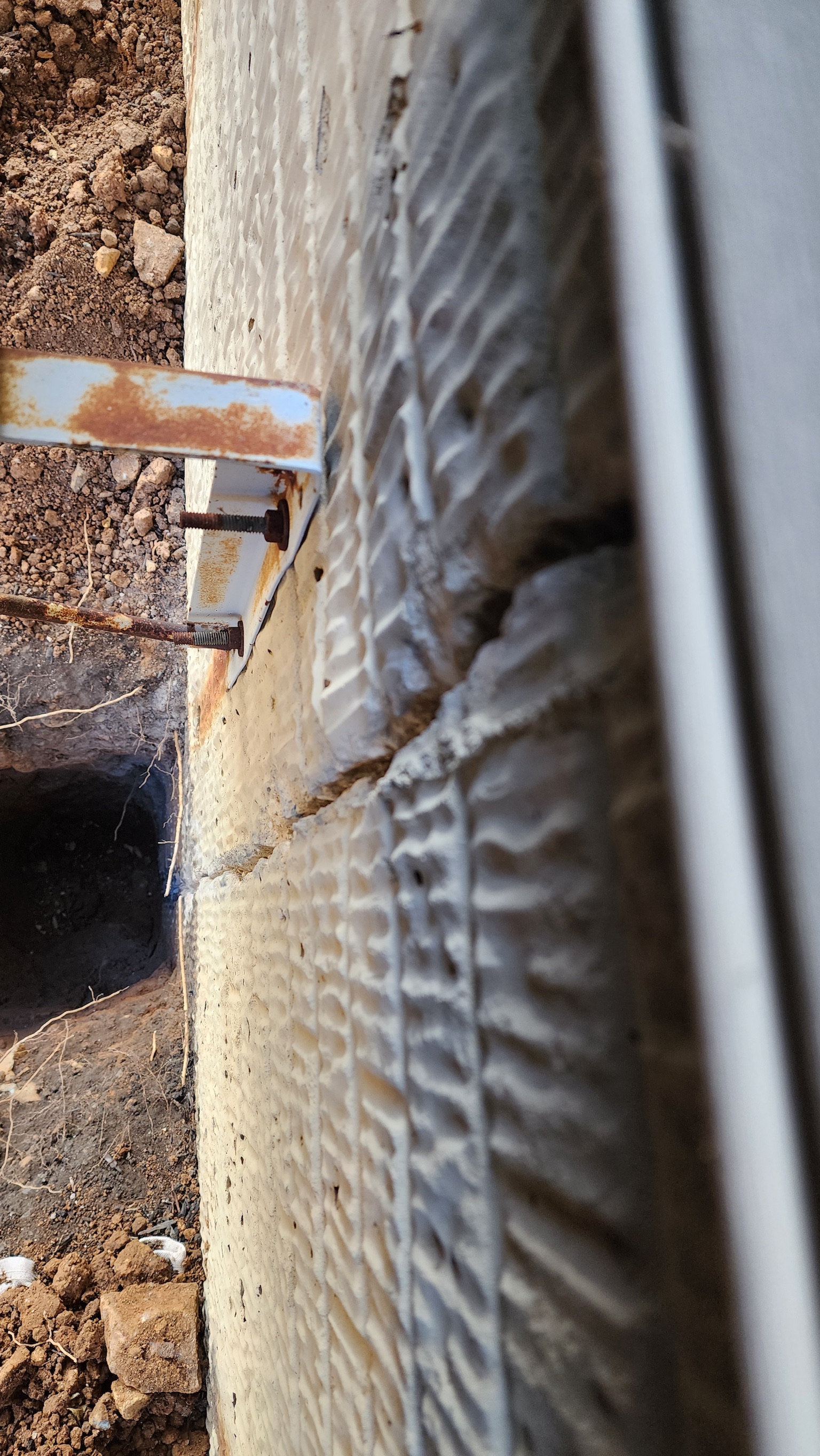
Hydrostatic Pressure. Clay Soil. Inward Force.
Why Maryland Foundation Walls
Bow — and When to Act
Foundation walls bow inward when the lateral pressure from saturated soil outside exceeds the wall's resistance. In Maryland, this almost always involves Piedmont clay — a soil type that holds water for extended periods after rain and exerts significant pressure against below-grade walls as it remains saturated.
Block walls (concrete masonry unit foundations common in Maryland construction from the 1940s through the 1990s) are particularly susceptible. The mortar joints between blocks are the weak point — under sustained lateral pressure, the mid-wall zone bows inward, often developing a horizontal crack at the mortar joint where the deflection is greatest. Poured concrete walls bow as well, but they tend to crack less dramatically and may show more of a smooth curve than a sharp angle at a crack.
Deflection is measured in inches — typically at mid-wall height, where the bow is greatest. This measurement determines the appropriate repair. Under 1 inch: carbon fiber stabilization. One to two inches: wall anchors, possibly with gradual straightening. Over 2 inches: excavation and rebuild is typically the structurally sound answer, though anchoring can stabilize walls in this range when full rebuild isn't an option. OBW measures every wall before making a recommendation.
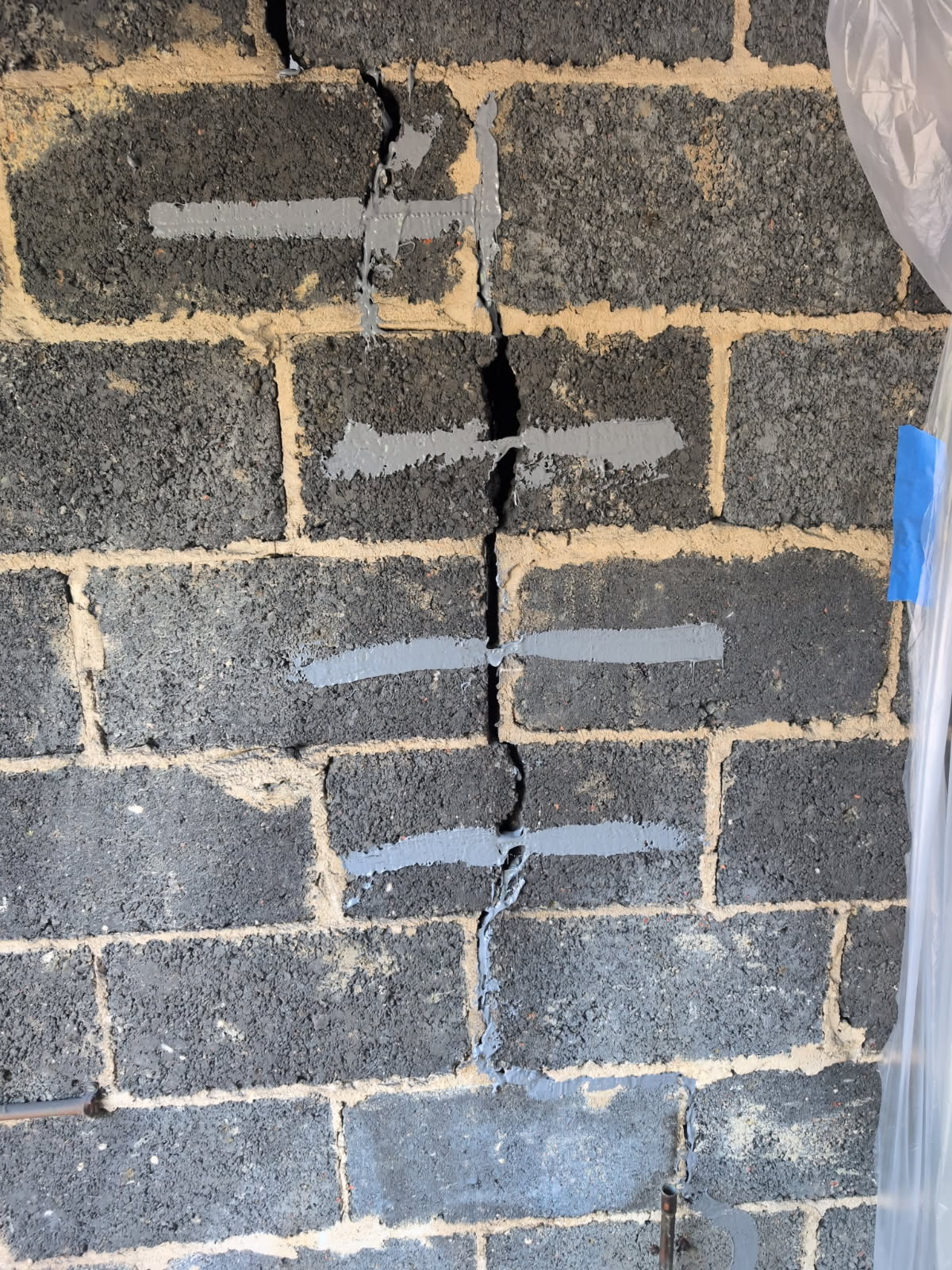
Block foundation wall bowing at mid-height — horizontal crack at mortar joint indicates where pressure is concentrated
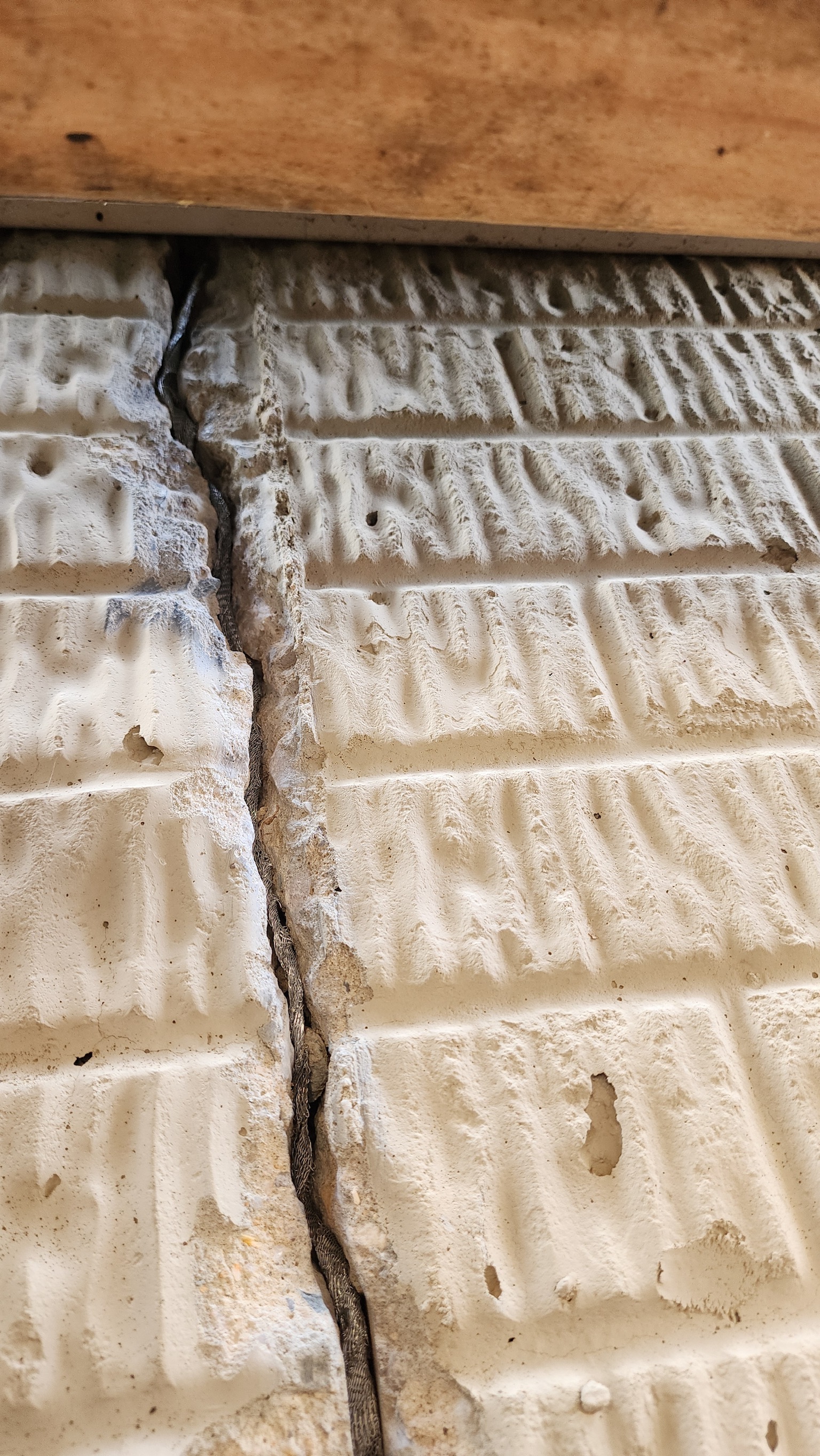
Signs Your Wall Is Bowing
Warning Signs of Inward Wall
Deflection in Maryland Basements
Bowing starts small and progresses with each wet season. These are the signs to watch for — and act on before the threshold for easy repair is passed.
- A horizontal crack running across the wall at mid-height — the most diagnostic single sign
- Visible inward bow when you stand back and view the wall — it curves toward you
- Floor gap at the base of the wall — the wall has moved in but the floor hasn't
- Diagonal cracks emanating from the ends of a horizontal crack — rotation sign
- Bow that is visibly worse each spring compared to the prior year
Repair Options
OBW's Bowing Wall Repair Services
The repair method is driven by the deflection measurement. OBW does not recommend carbon fiber for walls that need anchors, or anchors for walls that need excavation.
Deflection Measurement
We measure wall bow in inches at mid-height — the most critical data point for determining repair method and urgency. We document and photograph before any work.
Carbon Fiber Strap Stabilization
For walls under 1" deflection. High-strength carbon fiber bonded to the interior wall face resists further inward movement. No yard excavation required.
Wall Anchor Installation
For walls with 1–2" deflection where gradual straightening is the goal. Steel anchors extend from the wall face into yard soil, allowing periodic re-tightening.
Excavation & Rebuild Consultation
For walls over 2" deflection where anchoring is insufficient. OBW provides honest assessment and, where warranted, refers to licensed structural engineers.
Drainage Correction
Hydrostatic pressure is the cause. Interior drain tile and exterior drainage correction reduce the pressure load on the wall — making repairs more durable.
Written Urgency Assessment
Every bowed wall inspection delivers a written assessment of urgency, deflection measurement, and recommended timeline for repair.
The Process
How OBW Stabilizes a
Bowing Maryland Foundation Wall
Measure first. Recommend second. Install third. No exceptions to this sequence on structural work.
Deflection Measurement
We measure inward bow at multiple heights using a level and tape. This number drives the repair method recommendation more than any other factor.
Crack Pattern & Wall Condition Assessment
Horizontal cracks, spalling, and block integrity are assessed alongside the deflection measurement. A cracked bowing wall is more serious than a clean bowing wall at the same deflection.
Carbon Fiber or Anchor Installation
Straps are bonded under 1", anchors installed for 1–2". Both methods are installed by OBW's own crew in a single day for most residential applications.
Drainage Addressed
Reducing hydrostatic pressure extends the life of any structural repair. Interior drainage or exterior grading correction is recommended as part of every bowed wall job.
Recent Work
Bowing Wall Repairs
in Maryland
Each project below started with a deflection measurement. The repair method followed from the number.
Baltimore County 0.75" deflection — three carbon fiber straps stabilized the wall. No further movement two years later.
Harford County 1.4" deflection with horizontal crack — four wall anchors installed, gradual re-tightening schedule provided to homeowner.
Cecil County Block wall bowing at back corner — two straps and interior drain tile. Pressure relief reduced load on wall.
Carroll County 2.5" deflection — OBW provided honest assessment, referred to structural engineer, coordinated drainage correction alongside excavation.
Straight Answers on Bowing Walls
Bowing Wall Questions from
Maryland Homeowners
Call (443) 855-5600 if you are seeing inward movement. Our inspectors can tell you on the phone whether what you're describing sounds urgent.
How much bowing is too much? When does a wall become an emergency?
The general industry threshold for serious concern is 2 inches of inward deflection measured at the point of maximum bow — typically at mid-wall height. Below 1 inch, most walls can be stabilized with carbon fiber straps, which resist further movement but do not reverse existing deflection. Between 1 and 2 inches, wall anchors (steel plates tied to the soil behind the wall) may be able to gradually straighten the wall over time as anchor rods are periodically tightened. Above 2 inches, excavation and rebuild may be the only structurally sound option.
These thresholds are guidelines, not absolutes. A wall with 1.5 inches of deflection that also has an associated horizontal crack running through the blocks, with visible spalling or crumbling of the block face, is in worse condition than a wall with 1.5 inches of clean deflection and intact blocks. The crack pattern, block condition, footing integrity, and soil conditions all factor into the assessment.
Emergencies — walls where immediate action is needed — are walls showing rapid acceleration of movement, walls with multiple intersecting cracks, or walls where deflection is visible and clearly worsening season over season. If you can see your block wall bowing and it looks worse than it did a year ago, call now.
Can a bowed foundation wall be straightened back to plumb?
Yes, in many cases — but it depends on the repair method, the degree of deflection, and how long the wall has been in that position. Carbon fiber straps stop further movement but do not reverse existing bow. Wall anchors installed with a steel plate buried in the yard soil allow gradual straightening: as the wall is periodically re-tensioned — a simple bolt turn that most homeowners can do themselves — it slowly returns toward plumb. Significant straightening over one to two years is achievable with properly installed wall anchors in walls under 2 inches of deflection.
Walls with more than 2 inches of deflection are more complex. The soil behind the wall has been in a disturbed, compressed state for potentially years. The wall blocks themselves may have some structural compromise at crack locations. Pushing a severely bowed wall back to plumb risks cracking the wall further or disturbing the footing. In these cases, partial straightening — getting the wall stable and reducing deflection — may be the practical goal, with excavation and rebuild being the more complete solution if full restoration is required.
What is the difference between carbon fiber straps and wall anchors for bowing walls?
Carbon fiber straps are bonded vertically to the interior face of the wall using a high-strength epoxy. They work in tension — as the wall tries to bow further, the strap resists it. Carbon fiber is appropriate for walls with minor deflection (under 1 inch) where the goal is stabilization without further movement. It is a faster and less invasive installation than wall anchors, and it does not require any yard excavation. The limitation is that carbon fiber cannot reverse existing deflection — it holds what's there.
Wall anchors require drilling through the wall and driving a steel rod into the yard soil behind the wall, where a buried plate anchors the end. A steel plate is attached to the interior wall face over the rod, and a nut tightens the assembly against the wall. By periodically re-tightening the nut, gradual pulling-back of the wall toward plumb is achievable. Wall anchors can recover some deflection, but the yard needs to be accessible (no decks, patios, or driveways directly behind the wall) and the installation requires more disruption than carbon fiber.
OBW assesses which method is appropriate for your wall based on deflection measurement, wall condition, yard access, and the homeowner's goals for the repair. In some cases, a combination of both is used.
Does a bowed foundation wall always mean the house is in danger of collapse?
Not in the short term, in most cases. A wall that is bowing slowly and has been doing so for years without cracking or accelerating is a problem that should be addressed, but it is not typically an imminent collapse situation. The concern is that bowing walls worsen progressively — each wet season adds more hydrostatic pressure, each freeze-thaw cycle adds more movement. A wall with 1 inch of deflection this year will likely have more next year if nothing is done.
The situations that approach structural emergency: walls where deflection has accelerated rapidly (went from 1/2 inch to 2 inches in a single season), walls where the horizontal crack has propagated fully across the wall face and the wall appears to be rotating rather than bowing, and walls where the bowing section is supporting point loads from above (steel beam bearing on the wall at the bowed section, for example).
Get it assessed. An OBW inspector will measure the deflection, examine the crack pattern, and tell you honestly whether this is a 'address this spring' situation or a 'call a structural engineer today' situation.
What does bowing wall repair cost in Maryland?
Carbon fiber strap installation runs approximately $400–$700 per strap, with most bowed wall sections requiring two to four straps. A typical job with three straps runs $1,200–$2,500 depending on wall height and accessibility. The installation is minimally invasive and typically done in a single day.
Wall anchor installation runs approximately $700–$1,200 per anchor, with most walls requiring three to five anchors for a bowed section. A three-anchor job runs $2,100–$4,000. Excavation in the yard at each anchor location adds time but is usually hand-excavated for residential applications.
Excavation and wall rebuild — for walls over 2 inches of deflection where anchoring isn't sufficient — is significantly more: typically $15,000–$35,000 or more depending on the wall length, depth, and access conditions. This involves full exterior excavation to the footing, wall removal, new wall construction, waterproofing membrane, drainage, and backfill.
OBW provides written, itemized quotes after inspection. We measure before we quote — no phone estimates on bowed wall jobs.
Why Oriole
Why Maryland Homeowners Choose
OBW for Bowing Wall Repair
We measure deflection before recommending anything. That's not universal in this industry. It's how we avoid selling carbon fiber to walls that need anchors.
Measurement-Based Recommendations
OBW measures every bowed wall before recommending a repair method. Carbon fiber, anchors, or excavation — the deflection number drives the decision.
Maryland Clay Expertise
Piedmont clay creates the hydrostatic pressure that bows walls. OBW's 70 years of Maryland soil experience informs every repair recommendation.
Honest About Excavation
OBW will tell you when excavation and rebuild is the correct answer, even though it's beyond our standard repair scope. We refer to structural engineers when warranted.
Lifetime Transferable Guarantee
Carbon fiber and anchor installations carry OBW's Lifetime Transferable Guarantee — it transfers to the next homeowner when you sell.
From Satisfied Maryland Homeowners
What Maryland Homeowners Say About Bowing Wall Repair
★★★★★
"OBW measured the deflection before saying anything. Every other contractor just said 'you need wall anchors.' Oriole measured 0.7 inches and recommended carbon fiber — half the price, right call."
Carbon Fiber Stabilization
★★★★★
"They explained exactly what 1.2 inches of deflection meant and what would happen if I waited another season. I understood what I was buying. That's rare."
Wall Anchor System
★★★★★
"The inspector was upfront that my wall was borderline for anchors vs. excavation and laid out both options honestly. That transparency is why I hired them."
Bowing Wall Assessment
Bowing Gets Worse Every Season. Act Now.
Getting Started with
Bowing Wall Repair
The line between carbon fiber (fast, inexpensive) and wall anchors (moderate) and excavation (expensive) is measured in inches of deflection. Act before you cross that line.
Free Wall Measurement
OBW measures the deflection at your bowed wall, examines crack patterns, and photographs the conditions. Free, no obligation, same written summary as any repair inspection.
Method-Specific Quote
You receive a written quote specifying carbon fiber, wall anchors, or honest referral to excavation — based on your measured deflection. No single-method sales pitch.
Installation & Drainage
OBW's crew installs the structural repair and, where warranted, addresses the drainage source of the hydrostatic pressure. Lifetime guarantee upon completion.
That Wall Is Still Moving. Get It Measured.
Free assessment. Measurement-based recommendation. Lifetime guarantee on all repair work.
Family-owned since 1953 · MHIC #4247 · Lifetime Transferable Guarantee