
Foundation Repair · Wall Reinforcement
Carbon Fiber
Wall Reinforcement
in Maryland
Stop bowing foundation walls without excavating your yard — commercial-grade straps installed from inside your basement
Maryland's Piedmont clay generates lateral hydrostatic pressure that bows foundation walls inward over time. Carbon fiber straps bonded to the wall face redistribute that pressure and stop further movement. No excavation. No yard disruption. Stronger than steel at equivalent weight. Lifetime Transferable Warranty.
Stabilization Without Excavation
Why Bowing Foundation Walls
Happen in Maryland
Maryland's Piedmont and coastal plain soils are predominantly clay — a soil type that expands substantially when saturated and generates significant lateral pressure against foundation walls. Every major rain event increases that pressure. Every spring thaw cycle compounds it. Over months and years, this pressure bows block and poured-concrete walls inward at the midpoint, where resistance is lowest.
The traditional repair for a bowing wall was exterior excavation — dig down to the footing, relieve the pressure, and rebuild or brace the wall. That is still the right approach for severe structural failure. But for walls in the early to moderate deflection range, carbon fiber reinforcement achieves the same stabilization goal from inside the basement, with no excavation, no landscaping damage, and no exterior disruption.
OBW uses commercial-grade carbon fiber reinforcement panels — not the proprietary branded systems sold by national franchises. Commercial-grade means published tensile specifications, standardized installation protocols, and no franchise markup on the product. The structural performance is equal or better. The cost is lower.
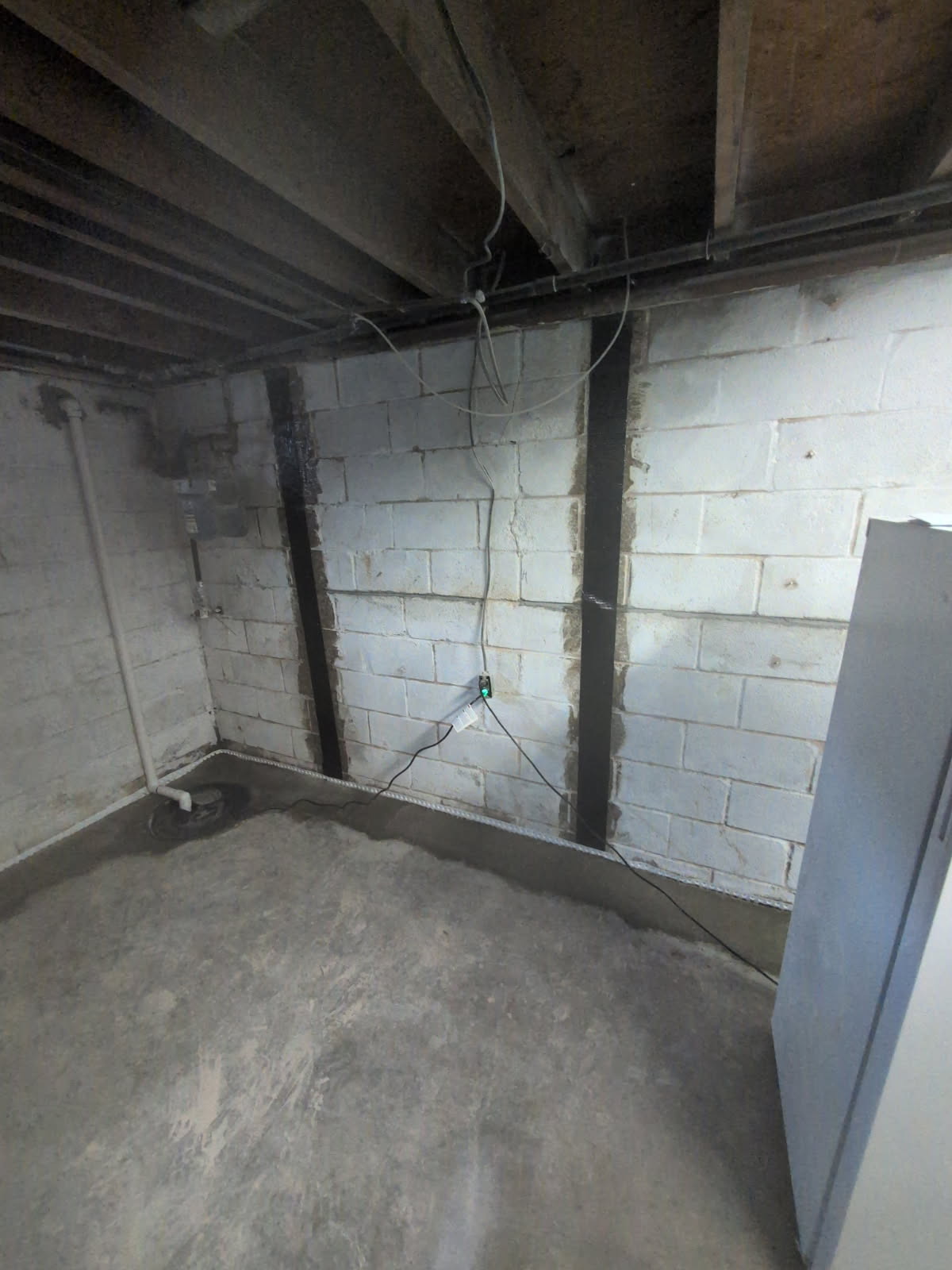
Commercial-grade carbon fiber bonded to bowing cinder block — OBW installation
Bowing Walls Get Worse Without Intervention
Signs Your Foundation Wall
Needs Carbon Fiber Reinforcement
Bowing walls are a progressive problem. Early intervention costs significantly less than structural failure. These are the signs to watch for.
- Visible inward curve or bow in a basement wall — especially visible from the end of the room
- Horizontal crack running through the middle of a block or poured-concrete wall
- Gaps appearing between the wall and the floor slab or the wall and the sill plate
- Stair-step cracking in block mortar joints combined with inward deflection
- Previously repaired cracks that have re-opened or widened — indicating ongoing movement
What You Get
What OBW's Carbon Fiber
Reinforcement Includes
Every installation starts with an honest measurement. We do not install straps until we know whether carbon fiber is the right repair for your wall's actual condition.
Commercial-Grade Carbon Fiber Straps
Not a proprietary franchise system — commercial-grade panels with published tensile strength specifications. Stronger than steel at equivalent weight. No franchise markup on the product.
Wall Deflection Measurement
We measure actual deflection before quoting. You get a specific number — not a vague assessment. This determines strap spacing, the number required, and whether carbon fiber is the right repair at all.
No Excavation Required
The entire installation happens from inside the basement. No yard disruption, no deck or driveway removal, no exterior landscaping damage.
Surface Preparation and Epoxy Bonding
Proper surface prep is what makes carbon fiber work. We grind and prepare the wall face to ensure maximum epoxy adhesion. A strap bonded to unprepared masonry is not a structural repair.
Honest Repair Scope Assessment
If your wall needs anchors instead of or in addition to carbon fiber, we will tell you. We do not sell straps to every customer with a bowing wall.
Lifetime Transferable Warranty
OBW's carbon fiber installations are covered by the Lifetime Transferable Warranty. Follows the property at sale — not just the original homeowner.
Interior Install. One Day.
How OBW Installs
Carbon Fiber Wall Reinforcement
Most carbon fiber installations complete in a single day. The process is methodical — surface prep determines whether the repair holds for decades or fails in years.
Deflection Measurement and Assessment
We measure wall deflection precisely, assess crack patterns, and determine whether carbon fiber alone is appropriate or whether wall anchors or additional repair is needed. You get an honest answer before we quote.
Wall Surface Preparation
The masonry face is ground and prepared to remove loose material and create a profile the epoxy can bond to. Skipping this step is why some carbon fiber installations fail. We do not skip it.
Carbon Fiber Strap Installation
Straps are bonded to the prepared wall face at spacing determined by deflection severity and wall type. Commercial-grade epoxy is applied under controlled conditions to ensure full bonding across the strap width.
Inspection and Warranty Documentation
The installation is inspected before we leave. Warranty documentation is provided. If a drainage repair was recommended alongside the structural work, we review the full scope and next steps with you.
Real Maryland Jobs
Recent Carbon Fiber Installations
Across Maryland
OBW-installed carbon fiber on Maryland block and poured-concrete walls — photographed before, during, and after every job.
Bowing block wall — four carbon fiber straps stabilized 1.2 inches of deflection. No further movement in two years.
Mid-wall horizontal crack combined with bowing. Anchors and carbon fiber combination — movement stopped.
Carroll County Commercial-grade carbon fiber straps bonded to bowing cinder block. Interior install, no excavation.
Poured concrete wall deflection caught early. Carbon fiber stabilization before structural threshold was crossed.
Honest Answers. No Sales Pitch.
Common Questions About
Carbon Fiber Reinforcement
If your question is not here, call (443) 855-5600. Our inspectors answer questions — they do not work on commission.
What does a carbon fiber strap actually do to a bowing foundation wall?
A carbon fiber strap is a high-tensile reinforcement panel bonded directly to the face of a bowing or deflecting foundation wall. It works by distributing lateral soil pressure across the full height of the wall rather than allowing it to concentrate at the midpoint where bowing typically begins. The strap itself is stronger than steel at equivalent weight — commercial-grade carbon fiber has a tensile strength several times higher than structural steel.
What it does not do, by itself, is pull the wall back to its original position. Carbon fiber straps stabilize the wall at its current deflection point and stop additional movement. If the wall has already bowed inward by more than a threshold amount — typically more than one inch per ten feet of wall height — OBW will tell you that carbon fiber stabilization is the right step but that you should not expect reversal of existing deflection without additional intervention like wall anchors.
Maryland's Piedmont clay soils are the driving force behind most bowing walls. Clay swells significantly when saturated and generates lateral hydrostatic pressure against foundation walls. Prolonged wet cycles — such as Maryland's spring saturation period — are when the most damage accumulates. Carbon fiber installation stops that cycle from compounding the damage further.
How do you measure wall deflection, and is my wall still repairable with carbon fiber?
Wall deflection is measured with a level or laser instrument against the plane of the wall — the distance the midpoint has moved inward from its original vertical position. We express this as inches of deflection over the wall height.
As a general guideline, walls with up to about one inch of deflection per ten feet of wall height are good candidates for carbon fiber stabilization alone. Walls in the one to two inch range may benefit from a combination of carbon fiber and wall anchors. Walls beyond that threshold typically need anchors, or in severe cases, replacement. These are guidelines, not hard rules — the actual condition of the wall material matters significantly.
The OBW inspector will measure your wall, assess the crack pattern, and give you an honest assessment of whether carbon fiber alone is appropriate or whether additional repair is needed. If you have noticed the wall moving recently — over weeks or months — that active movement changes the calculus. We need to assess whether the movement is stabilizing or accelerating before deciding on repair scope.
Does carbon fiber installation require excavating the yard or removing interior finishes?
No. This is one of the primary advantages of carbon fiber over older repair methods. The installation happens entirely from inside the basement. No yard excavation, no disruption to landscaping, driveways, decks, or exterior structures.
Inside the basement, the strap installation requires access to the full height of the wall face. If you have a finished basement with drywall against the affected wall, that section will need to come down to expose the masonry. This is typically a section two to three feet wide per strap location. Straps are spaced at intervals determined by the degree of deflection — usually four to six feet apart along a bowing section.
The strap itself sits nearly flush against the wall surface once installed and can be covered with new drywall after installation. Most homeowners find the restoration footprint quite manageable.
Is OBW using a name-brand carbon fiber system or a commercial product?
OBW sources commercial-grade carbon fiber reinforcement panels, not a proprietary branded system sold by a national franchise. Proprietary franchise systems are often sold as complete packages that can only be serviced or warranted by that franchise. If the franchise exits your area or goes out of business, you may have no recourse for warranty work.
Commercial-grade carbon fiber is a standardized industrial product with published tensile strength and bonding specifications. The installation method follows established structural engineering guidelines rather than proprietary protocols. This also affects cost — franchise systems carry brand premium built into the price. OBW's pricing reflects actual material and labor costs, which is one reason we consistently come in below national chain quotes for equivalent scope.
When is carbon fiber not the right answer, and what else might OBW recommend?
Carbon fiber is the right answer when the primary problem is wall deflection that needs to be stopped and the wall material is sound enough to accept bonding. It is not the right answer in several situations.
If the wall has already deflected significantly beyond the one-inch-per-ten-feet threshold, wall anchors become the preferred option because they can be tightened over time to gradually pull the wall back. Carbon fiber stabilizes; anchors can reverse movement.
If the wall has significant horizontal cracking — especially a clean horizontal crack running through the center of a block wall — that may indicate the wall has already failed structurally at that joint. Carbon fiber bonded below or above that break point cannot bridge a failed joint the way it bridges a deflecting continuous wall.
If water intrusion is the primary complaint and the wall is only mildly deflecting, addressing the drainage and hydrostatic pressure may be the right first step before any structural reinforcement. OBW will tell you if that is the recommended sequence rather than selling you carbon fiber straps when drainage repair would solve the underlying problem.
70 Years of Maryland Foundations
Why Maryland Homeowners Choose
Oriole Over National Brands
Three generations of the Pirog family. No commissioned salespeople. Mid-pack pricing with commercial-grade materials.
Commercial Grade, Not Franchise Brand
We use commercial-grade carbon fiber with published specs — not a proprietary branded system that only the installing franchise can service. Your warranty is with OBW, not a national call center.
Measured Before Quoted
We measure actual wall deflection and tell you the number. If your wall is beyond the carbon fiber threshold, we tell you that too — and quote what it actually needs.
No Excavation, No Yard Disruption
Interior-only installation. Maryland homeowners with finished landscapes, tight lot lines, or decks against the affected wall get the same structural reinforcement without exterior disruption.
Family-Owned Since 1953
Founded by Frank Pirog Sr. Amber Pirog leads the company today. No commissioned salespeople. No national franchise overhead. Your estimate reflects actual scope.
From Satisfied Maryland Homeowners
What Maryland Homeowners Say About Carbon Fiber
★★★★★
"Installed in one day, no excavation, no landscaping damage. The wall hasn't moved in three years — I check it every spring."
Carbon Fiber Stabilization
★★★★★
"My inspector was clear that carbon fiber holds what's there, it doesn't reverse deflection. That honesty helped me make the right decision."
Carbon Fiber Assessment
★★★★★
"Three straps in a morning. The wall looks fine, and I have the warranty in writing. Clean and fast."
Carbon Fiber Strap Installation
Ready When You Are. No Pressure.
Three Steps to a Stabilized
Foundation Wall
From first call to completed installation, most carbon fiber jobs are scheduled and done within one to two weeks.
Schedule a Free Inspection
An OBW inspector visits, measures your wall deflection, and determines whether carbon fiber is the right repair — or whether anchors or additional intervention is needed.
Get Your Written Estimate
You receive a written, itemized quote the same day. The actual deflection measurement is in the paperwork — not a vague description of "some bowing."
One-Day Installation
Most carbon fiber jobs complete in a single day. Interior-only access. No excavation. Warranty documentation before the crew leaves.
Is Your Foundation Wall Bowing?
Free inspection. Written estimate same day. Commercial-grade carbon fiber, not a franchise system.
Family-owned since 1953 · MHIC #4247 · Lifetime Transferable Guarantee